A STATEMENT OF PHILOSOPHY
The Clinical CEO Manifesto
For therapist building work that holds
I'm a psychotherapist who built four mental health businesses, and I learned everything in this manifesto the hard way. This is what I believe now. There is a version of success that looks impressive from the outside, and quietly hollows a person out from the inside.


There is a version of success that looks impressive from the outside, and quietly hollows a person out from the inside.
WHAT I HAVE SEEN
The same pattern, in every room.
I've watched talented professionals exhaust themselves chasing growth that never resolves into stability.
The pattern is consistent. The business grows around their skill. Slowly, it begins to depend on their time, energy, decision-making, and emotional labor. The cost shows up as less patience, less creativity, less presence. More urgency, more pressure, more guilt.
Eventually they ask the question I used to ask myself.
Why do I feel this way when I built the thing I said I wanted?
From the outside, it looks like ambition. From the inside, it is exhaustion, guilt, and the quiet panic that everything will collapse if you stop holding it up.
What is called success in this field is often just burnout we have all agreed to stop noticing.
THE CORE BELIEF
Sustainable success is built by
carrying more.
Sustainable success is built on structure.
THE REAL PROBLEM
The gap is not what you've been told it is.
The gap between a clinician who can build a sustainable practice and one who cannot is not a question of who is smarter, who works harder, or who is more skilled in the room with the client.
It is not intelligence.
It is not effort.
It is not clinical skill.
It is structure.
Someone has to teach you how the practice behind the practice works, or you will spend years rediscovering what has already been figured out.
I know, because I spent those years.
THE HUMAN COST
A success that cost me everything around it.
There was a stretch of years when I was running my first practice and selling cars full-time to keep it alive.
I worked seven days a week for years. I missed family dinners. I missed tucking my daughter in at night.
I was a present parent in name and an absent one in practice.
I had convinced myself that was the cost of building something, and that if I just pushed harder, eventually I would arrive somewhere that made it worth it.
I had built a business that could not exist without me sacrificing everything around it. And I called that success.
I almost shut the whole thing down that year. The story of why I did not is one I have written elsewhere.
What matters here is what I learned. There is a price you pay when you build a practice on top of your own body and your own family, and the field will let you keep paying it for as long as you are willing.
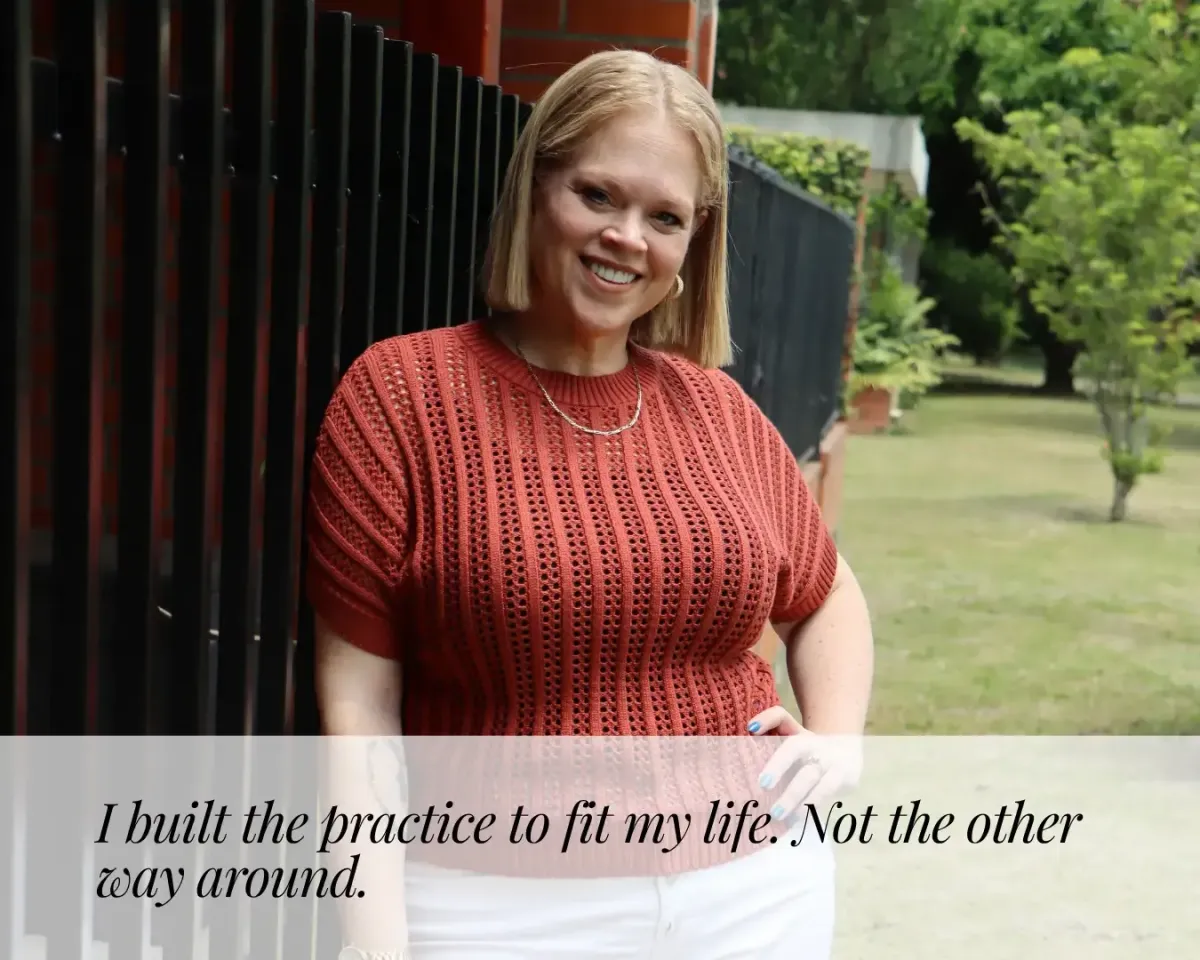
My life looks very different now, and that is the point. I work hard. I have a lot of moving parts. But I am off by five in the evening. I do not miss family events. I have taken extended time away from the businesses and come back to find them strong, profitable, and exactly where I left them.
WHAT MOST PEOPLE MISS
Expertise and leadership are not the same skill.
You can be a brilliant clinician and have no idea how to run a company. That does not mean you are failing. It means you were trained for one role and have chosen another role without knowing that you needed a manual.
Caring professionals are trained to serve, respond, support, and help. Then they wake up one day responsible for pricing, hiring, policy, finance, conflict, and the difficult conversations no one prepared them for. Those are not natural extensions of clinical training. They are different muscles entirely.
The other miss is even more important.
Most business problems are not operational. They are behavioral. They are leadership problems wearing a business costume.
A revenue dip is rarely a marketing failure. A team in chaos is rarely an org chart issue. A founder who cannot step away is rarely solving the right problem.
Clinical work trains you to ask different questions. What pattern is repeating? What is being avoided? Where is the lack of clarity? What is being protected by keeping things exactly the way they are?
You have to move from being the expert to being the CEO of the work. The CEO role does not replace care. It protects it.
ETHICAL GROWTH
Growth that protects what it touches.
Ethical growth is not a marketing phrase. It is a way of making decisions when no one is watching.
It asks better questions than how do we make more money or how do we get more clients. Those questions are fine. They are also incomplete.
The fuller list looks like this.
Can we serve people well at this size?
Do the systems actually exist to support this growth?
Are we honest in our marketing?
Are we protecting client trust?
Is the team clear on their roles?
Are we making decisions that match our values, especially when those decisions are inconvenient?
This matters in every business. It matters more in healthcare, therapy, court-related work, and education, because people come to you during vulnerable moments and trust you to know what you are doing.
Growth without ethics turns into taking advantage of people. Growth without structure becomes chaos. Growth without leadership harms the people served and the people serving.
Ethical growth is not the slower path. It is the only one that holds.
STRUCTURE AS CARE
Systems are not the opposite of care.
They are how care holds.
People assume structure makes work less human. The opposite is true.
When you work in clinical care or court-related services, sloppy documentation is a risk to the people you serve. A vague policy, a missing consent, an unclear communication, or a poorly handled boundary can change someone's life in a way you cannot take back.
Systems are not bureaucracy. They are part of ethical care. They are the way you protect clients, support staff, and keep the work consistent when emotions are high, or someone is having a hard day.
Structure is what allows the human work to happen safely, every time.
Boundaries belong in this same category. They are not a weapon against people. They are the architecture that makes care sustainable.
Without them, professionals overgive, overfunction, rescue, avoid difficult conversations, and accumulate quiet resentment. That is not generosity. That is a system running without support.
A REFRAME ON BURNOUT
It is not a character flaw. It is a structural output.
The advice on burnout is almost always personal. Rest more. Take a vacation. Practice self-care. Set better boundaries. Fix your mindset.
Those things can help. I am not against any of them. But they are not the answer when the system that produced the burnout is still running in the background.
Most of the burned-out people I work with are the most committed, most responsible, most overfunctioning people in their entire industry. That is exactly the problem.
In a practice, burnout almost always has a structural cause. Founder dependence. Every problem routes through one person. Every client question, team issue, decision, and emergency lands in the same inbox.
Eventually, the company is running on the founder's nervous system. And nervous systems are not designed to be infrastructure.
You cannot adjust your mindset out of a model that requires your constant overextension. The shift is not to care less. The shift is to build something that does not require you to disappear inside it.
THE PHILOSOPHY
Meaningful work still needs structure.
There is a belief in caring industries that if the mission is good enough, the rest will work itself out. It will not.
Passion does not replace systems. Care does not replace leadership. Talent does not replace strategy. The mission is the reason you start. The structure is the reason it lasts.
If you are building something that affects people's lives, you owe it the underlying architecture. Systems, boundaries, team structure, communication, documentation, and the leadership capacity to hold all of it without disappearing inside the work.
You can care deeply about your work without letting it consume your life. You can build something ambitious without sacrificing your health, your family, or your identity.
The goal is not just to build something impressive. It is to build something that can last, serve well, and support the people inside it. Including you.

Care requires structure.
Work should not require self-abandonment.
If this perspective names something you have been sensing, you can explore my work further.